
Last updated November 15, 2026
 Whole-home duct cleaning
 Dryer vent cleaning
 Camera inspection
 Sanitizing & deodorizing
Whole-system duct and dryer vent check with before-and-after photos - you see exactly what came out of your vents
That "$99 whole-house special" is a bait ad - the real number appears once they are in your hallway, or the "clean" is a shop-vac at the register. We photograph the inside of your ducts before and after instead.
Air Duct Cleaning Permits, Codes & Inspections in Richmond, CA: What You Need to Know
No permit is required to clean your ducts. That part surprises most people who call us expecting a paperwork headache. But if that cleaning reveals a disconnected trunk line that needs reconnection, or a flex duct section that needs replacement, the repair work that follows may fall under different rules under California mechanical codes. The line between maintenance and regulated mechanical work is where Richmond homeowners get tripped up.
This guide draws that line clearly. You’ll learn when a City of Richmond permit is typically triggered, how California Title 24 energy requirements intersect with duct sealing and replacement, what disclosure obligations come up during a Richmond real estate transaction, and what documentation you should have in hand after any duct work is done.
Quick Answer
Cleaning the inside of your air ducts does not require a permit in Richmond or anywhere in California. Duct repair that involves cutting into the system, replacing components, reconnecting runs, or altering the system’s configuration typically falls under mechanical work and may require a permit from the City of Richmond building department. Duct sealing or replacement work may also bring California Title 24 energy compliance requirements into play. When in doubt, ask your contractor to state in writing whether the scope of work requires a permit, and verify with the city before work begins.
Styles & brands we work with
- Whole-home duct cleaning
- Dryer vent cleaning
- Camera inspection
- Sanitizing & deodorizing
Table of Contents
- Cleaning vs. Duct Repair: Where Permits Enter the Picture
- What California Mechanical Code Says About Duct Work
- The Title 24 Connection: When Efficiency Rules Kick In
- Duct Condition and Richmond Real Estate Disclosures
- What a Contractor Should Give You in Writing
- Licensed HVAC Contractor vs. Cleaning-Only Service
- How a Duct Inspection Should Go in Richmond
Cleaning vs. Duct Repair: Where Permits Enter the Picture
The simplest way to think about this: cleaning is maintenance, and repair is construction. Maintenance doesn’t need permits. Most construction does. The confusion comes because the two things often happen on the same visit.
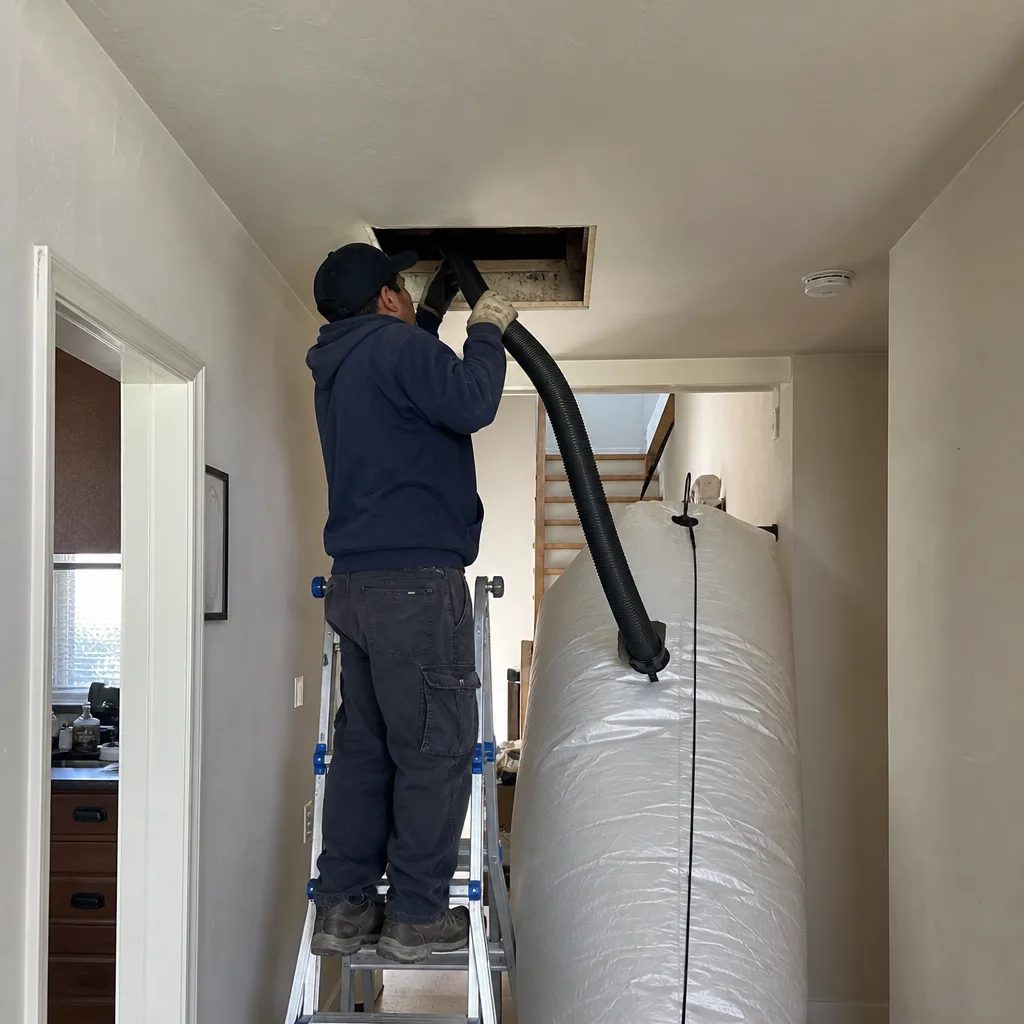
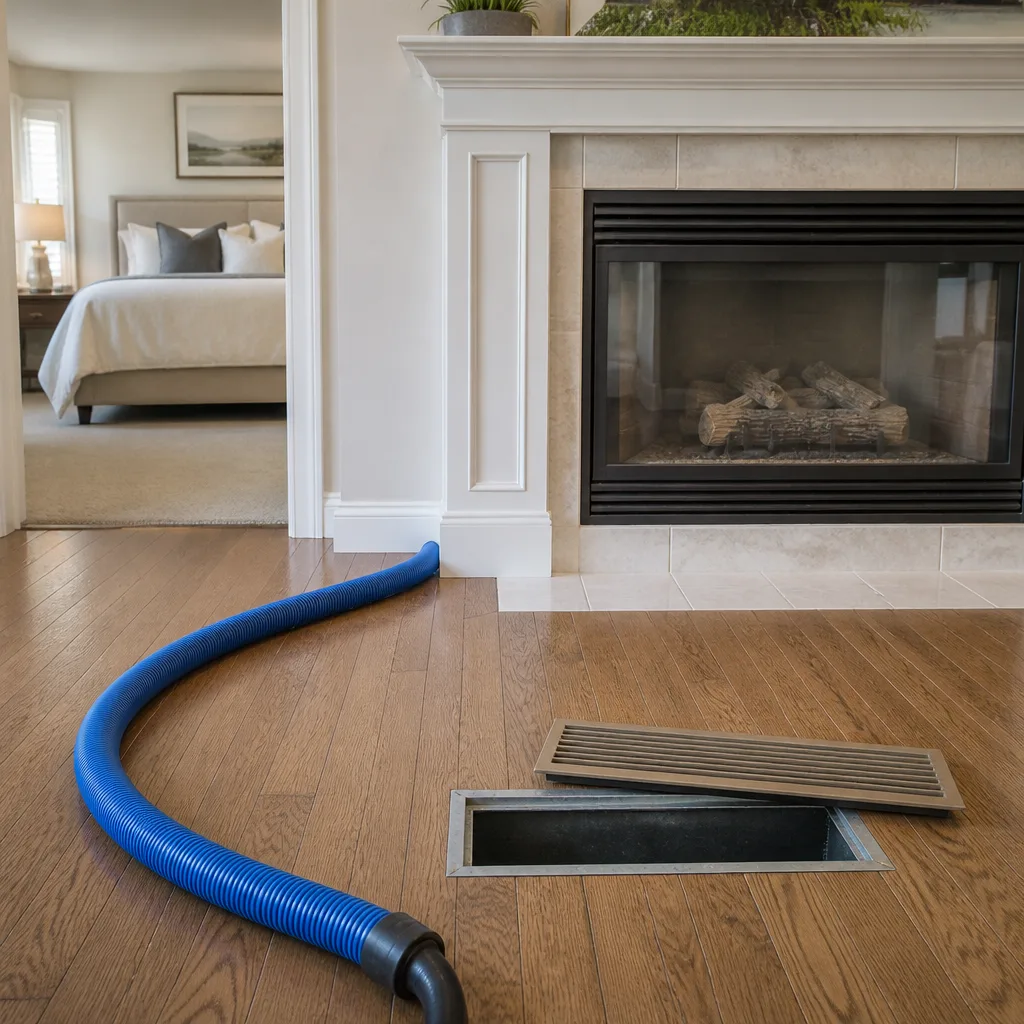
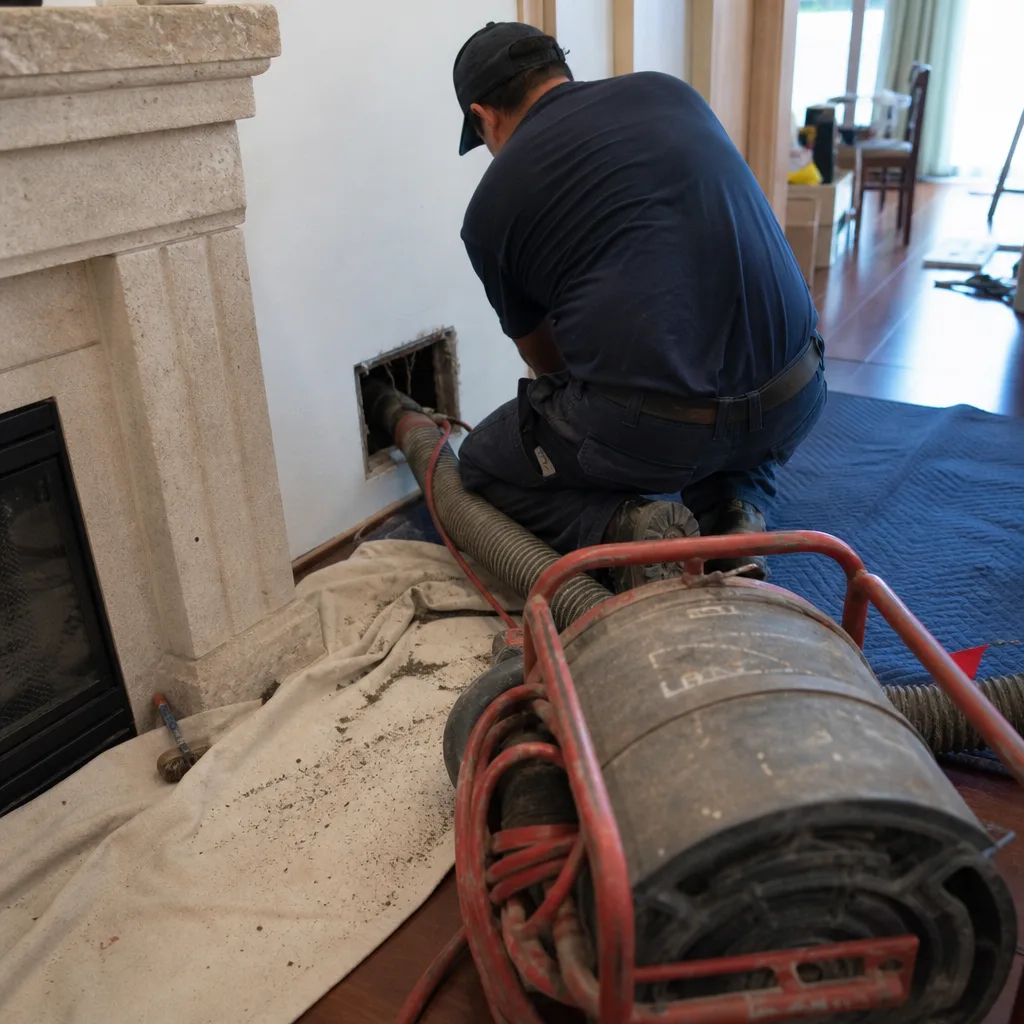
Cleaning involves running mechanical agitation and HEPA-rated vacuum extraction through the existing duct system. Rotobrush rotary brush systems and Nikro HEPA vacuums are built for exactly this. Nothing is added, cut, or modified. No permit is involved in a routine air duct cleaning.
Repair is different. When we find deteriorated ducts during a cleaning job in Richmond – a disconnected trunk line, a crushed flex run, a joint that has pulled apart behind the drywall – the fix often means:
- Cutting and replacing a section of duct
- Reconnecting a run that has separated from a trunk
- Replacing deteriorated flex duct with new material
- Altering the system’s layout or adding a new branch
Those categories cross into mechanical work. In most California jurisdictions, including Richmond, that is the point where a permit may be required from the city’s building department. The threshold isn’t perfectly uniform – some modifications are minor enough to need no permit, others are not – so the practical answer is to ask before the work happens. A contractor who identifies needed repairs should be able to tell you, clearly, whether that particular repair needs a permit.
If no repair is needed, you’re done. If one is, you want a contractor who can actually perform both, so you aren’t left calling a second company. We clean it. If it’s broken, we fix it.
What California Mechanical Code Says About Duct Work
California’s mechanical code governs how duct systems are installed, connected, and sealed. It is written to make sure duct work moves air where it’s supposed to, doesn’t leak conditioned air into an attic or crawlspace, and doesn’t create a hazard. Cleaning doesn’t touch any of that. Duct repair does.
Broad categories of work the code concerns itself with:
- Connection integrity. Duct joints, seams, and connections to equipment must be secured and sealed so the system doesn’t lose air at the connections.
- Material requirements. Duct materials and sealing materials carry standards for durability and fire safety, particularly where ducts pass through areas like attics or garages.
- Support and clearances. Duct runs need proper support and clearance from other building components, including combustion appliances and heat sources.
- Alterations. When a system is extended or reconfigured, the new work needs to be installed to the same standards as original construction.
Richmond’s housing stock is varied, and that matters here. The city includes older neighborhoods where original duct systems were sized and installed decades ago, plus newer construction and multifamily properties along the waterfront and in the Iron Triangle. In older homes, we regularly find ducts that were installed to whatever standard was accepted at the time, which means a repair is sometimes less about patching a single failure and more about bringing that section up to current expectation.
For a homeowner, the practical takeaway is this: when a repair is proposed, ask whether the repair as scoped will satisfy code requirements for connections, sealing, and material. A contractor who can’t answer that clearly is telling you something.
The Title 24 Connection: When Efficiency Rules Kick In
California’s Title 24 energy code applies to duct work whenever the work crosses out of maintenance and into alteration or replacement. Cleaning alone doesn’t trigger Title 24. Sealing large portions of the system, replacing duct runs, or altering the system’s configuration can.
What that means for a Richmond homeowner in practice:
- Permitted repairs may carry energy compliance requirements. When a permit is pulled for duct work, the work may need to meet Title 24 duct sealing and insulation standards rather than just being patched to look intact.
- Sealing standards are stricter than people assume. Ducts in unconditioned spaces – an attic or crawlspace, common in many Richmond homes – are held to sealing requirements because they lose the most conditioned air.
- Replacement materials matter. If a flex run is replaced, the replacement should meet insulation and sealing standards, not simply match what was there.
This is one of the reasons we push for real diagnostic work over guesswork. A cleaning-only service that finds torn flex duct may patch it as best it can. A company that also does air duct repair can tell you what the repair actually needs to include, and whether a permit and Title 24 compliance come into play.
Two things we hear from Richmond homeowners worth addressing directly. First: “I don’t want to open a can of worms.” If the system is truly fine, cleaning is all it takes, and we say so. Second: “The last company just cleaned what they could see.” That’s not an inspection. A proper look into the system means looking at the connections, not just the duct interiors.
Duct Condition and Richmond Real Estate Disclosures
In a Richmond real estate transaction, duct condition isn’t usually a headline item the way a roof or foundation might be. But if a licensed contractor documents deteriorated ductwork, that documentation can become material to the sale. In California, sellers are generally required to disclose known material defects. A written report from a contractor documenting disconnected or deteriorated ducts is not something that can be quietly forgotten.
Where this shows up most often:
- Pre-listing inspections. Sellers who have their ducts inspected before listing sometimes learn about issues they can address or disclose on their own terms.
- Buyer’s inspection contingencies. A buyer’s inspector flags visibly damaged flex duct or disconnected runs in the attic or crawlspace; a contractor report follows.
- Older Richmond homes. In neighborhoods with significant older housing stock, buyers now routinely ask about duct condition as part of due diligence.
The practical advice: if you’re selling and you’ve had duct work done, keep the documentation. If you’re buying and a report comes back flagging duct issues, get a clear statement of what the repair involves and whether it needs a permit. A report that says “disconnected duct in attic” is a starting point, not a repair quote.
Property managers of Richmond’s multifamily buildings run into this in a different way: a written record of duct condition, cleaning and repair across units is the kind of thing that makes future inspection and maintenance planning far less painful.
What a Contractor Should Give You in Writing
Documentation is the part most homeowners underweight. It’s also the part that pays off at resale, in an insurance claim, and if you ever need to prove the work was done. After cleaning and repair work in Richmond, ask for a written record that includes:
- Scope of the cleaning. Which systems and which sections were cleaned.
- Findings. Any issues identified during the cleaning, with plain descriptions and, where possible, photos.
- Repair performed. Exactly what was repaired or replaced, and in what location.
- Permit status. Whether a permit was required for any portion of the work, and whether one was obtained.
- Materials used. For repair work, what materials were used and where.
- Before-and-after photos. Interior photos of the ducts before and after. This is the cleanest proof of what was actually done.
If a contractor can’t provide before-and-after photos of the ducts themselves, that’s a red flag. It means you can’t verify the work. That matters far more than a slick invoice.
Licensed HVAC Contractor vs. Cleaning-Only Service
This is the fault line that matters most when repairs come up. Air duct cleaning doesn’t require an HVAC contractor license, which is why cleaning-only companies exist and do useful work. Duct repair, when it crosses into mechanical work, generally does.
So the sequence matters:
- If a cleaning turns up nothing. You get a clean system and a written report. No license question involved.
- If a cleaning turns up a minor, contained issue. It depends on the scope. Some repairs require a licensed HVAC trade contractor; some are within the cleaning company’s scope.
- If a cleaning turns up a significant problem. A disconnected trunk, deteriorated flex in an unconditioned attic, a system that needs reconfiguration – that should involve a licensed HVAC contractor, a permit where required, and a documented scope of work.
Our answer to this is straightforward. We do air duct cleaning, dryer vent cleaning, and air duct repair. We can also work alongside major indoor air quality systems – Honeywell and Aprilaire among them – when your home has whole-home air quality components that interact with the duct system. When the repair as scoped is beyond what a duct cleaning company should perform, we say so. That’s part of the job.
How a Duct Inspection Should Go in Richmond
A duct inspection in Richmond should be about more than looking at what’s visible from the register. It should involve looking into the system and documenting what’s there. Here’s what a proper inspection typically looks like:
- Visual survey of the accessible system. Registers, returns, and accessible trunk and branch runs – often in the attic or crawlspace.
- Camera inspection of duct interiors where access permits. This is how deteriorated flex duct, disconnected runs, and debris accumulation get identified.
- Connection checks. Where the system connects to equipment, and where runs connect to trunks. Disconnected joints are one of the most common findings we see.
- Air quality systems check. If your home has filtration or humidification components, those are part of the picture.
- Written documentation. Findings written out clearly, with photos where possible.
What a good inspection doesn’t do is sell. If the system looks fine, that’s the finding. If it doesn’t, the finding is specific and the proposed repair is specific. That’s the standard to hold any contractor to, whether that contractor is in Richmond or anywhere else in the East Bay.
Common Mistakes to Avoid
- Assuming cleaning covers it. If you had ducts cleaned but no one ever looked at the connections, damaged flex, or the run behind the drywall, you don’t really know the system’s condition. Cleaning good ducts is worth doing; cleaning over a broken connection isn’t.
- Skipping the permit question on repairs. A repair that needed a permit and didn’t get one is a problem you inherit. Ask explicitly whether the repair as scoped requires a permit in Richmond, and get the answer in writing.
- Trusting “we’ll just patch it” on non-trivial repair. A quick patch on a disconnected trunk or deteriorated flex run may hold for a season and fail later. Get clear repair scope, not just a verbal promise.
- Not keeping the documentation. Written reports, photos, and permit records are the point. They matter at resale, in a claim, and if a future contractor needs to understand what was done before.
- Using a cleaning-only company for repair work. Repair that crosses into mechanical work should involve a licensed HVAC contractor and, where required, a permit. A cleaning company that patches ductwork on the side shouldn’t be doing the work a licensed trade contractor is set up to do.
- Assuming Title 24 doesn’t apply. It applies to alterations and replacements, not cleaning. If a permitted repair is being proposed, Title 24 energy compliance may enter the picture. Ask.
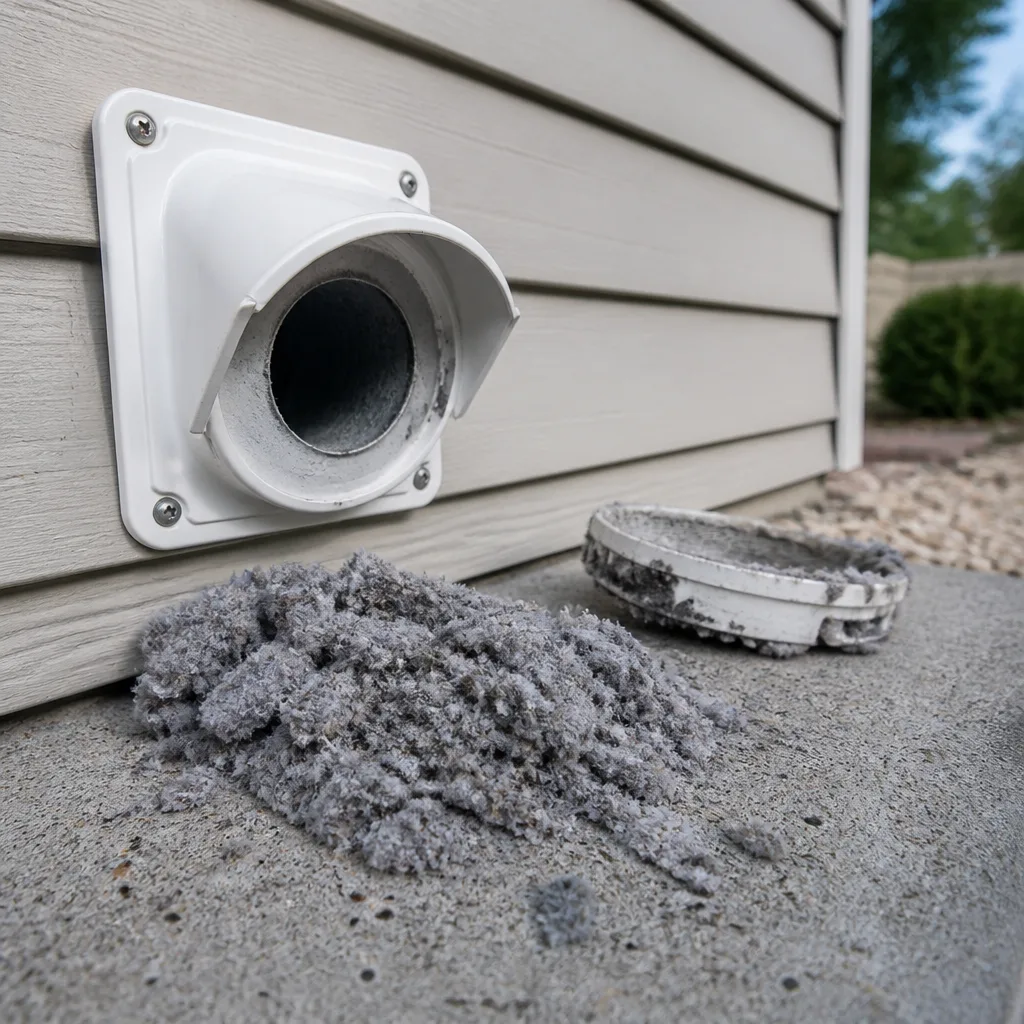
- Ignoring dryer vent in older Richmond homes. This isn’t strictly a duct cleaning topic, but in many Richmond homes dryer vents are aging too. Ensuring that vent is clear and properly connected is the kind of safety check worth bundling with duct work.
See the difference
 Before
 After
 Before
 After
 Before
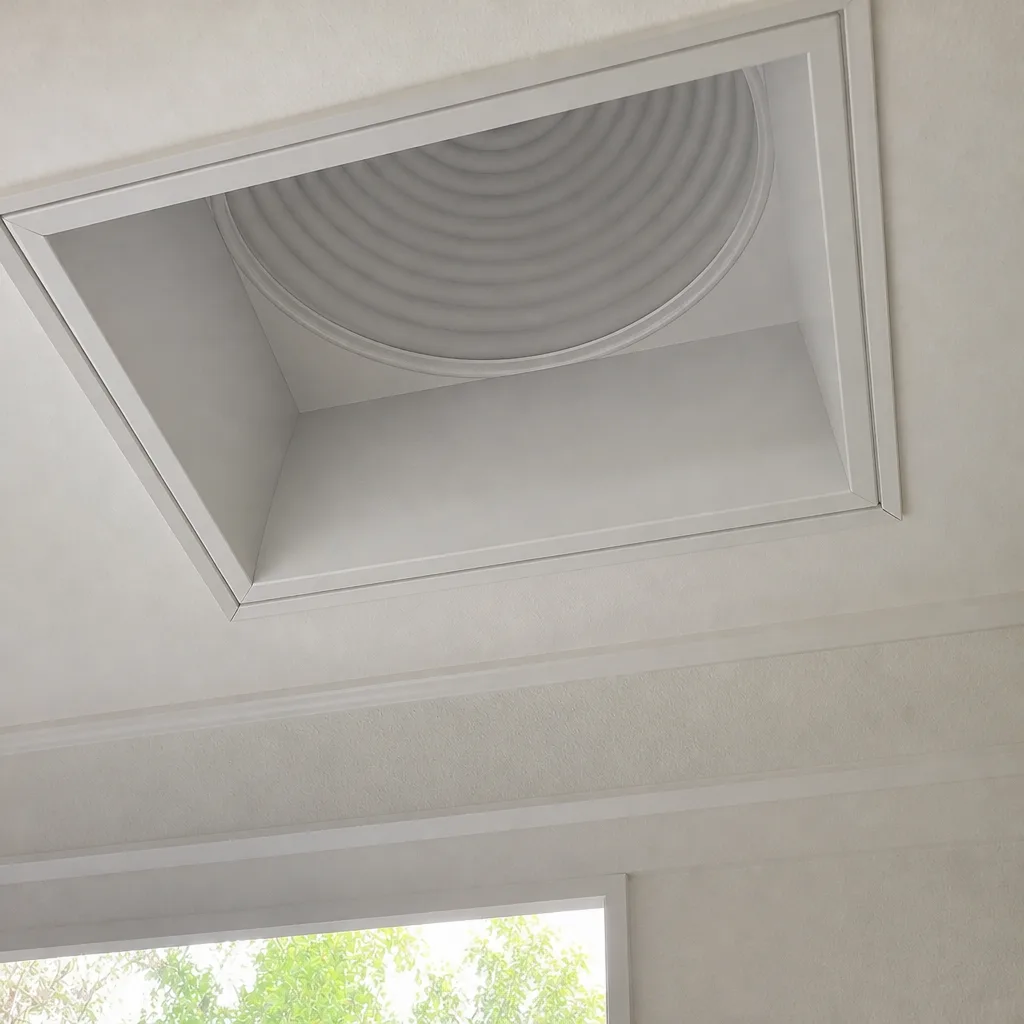 After
When to Call a Professional
Some duct situations are clearly a professional call. A tech who notices flex duct torn open in the attic, a disconnected run behind the drywall, visible debris buildup near the equipment, a return that’s pulling more air than it should, or a duct system that’s newly noisy or suddenly underperforming – those are the moments to get someone out to look rather than guess. In our experience, Richmond homes from different eras present different issues, and the right answer depends on what’s actually inside the system. Meadow Air Duct Cleaning offers free estimates in Richmond, and estimates are always free. Call Meadow Air Duct Cleaning at (844) 459-0252. We answer 24/7. Fast dispatch from 7am to 7pm, Sunday through Friday. Estimates are free, and the price is set per job by the written estimate.
Frequently Asked Questions
No. Cleaning the interior of your air ducts is maintenance and does not require a permit in Richmond or anywhere in California. If the cleaning identifies a repair that involves cutting, replacing, or reconnecting duct components, that repair may require a permit from the City of Richmond building department. Call (844) 459-0252 to talk through your specific situation.
Not always. Minor, contained repairs may not require a permit, while repairs that alter the system’s configuration, replace significant duct runs, or reconnect failed components may. The City of Richmond building department can confirm for your specific scope. If you’re uncertain, ask your contractor to state in writing whether a permit is required – a clear answer from the contractor is your first check.
Title 24 applies when duct work crosses from maintenance into alteration or replacement. Cleaning alone doesn’t trigger it. Replacing duct runs, sealing significant portions of the system, or altering system configuration can. If a permit is being pulled for duct work, ask whether Title 24 energy compliance requirements apply to the repair.
Yes. California requires sellers to disclose known material defects, and a written contractor report documenting deteriorated or disconnected ductwork can become part of the disclosure picture. If you’re selling, keep your documentation. If you’re buying and a duct report comes back with findings, ask for a clear statement of what the repair involves and whether a permit is required.
Cleaning-only services clean the system; duct repair that involves mechanical work, including cutting, replacing, or reconnecting duct components, generally requires a licensed HVAC trade contractor and often a permit. Meadow Air Duct Cleaning offers cleaning and repair – and when a repair goes beyond what a duct cleaning company should perform, we tell you so and recommend the right trade.
Rarely. Most of what matters is inside the duct system or behind walls and insulation – disconnected runs, deteriorated flex duct, and failed connections. An inspection that includes a camera and connection checks is the way to know. If you notice a sudden drop in airflow, strange noise from the system, or visible flex duct damage in an accessible area, that’s a reason to schedule an inspection.
The Bottom Line
Cleaning your ducts in Richmond doesn’t require a permit. Repair work can – and Title 24 energy compliance and California mechanical code requirements may follow a repair that crosses from maintenance into alteration. Get the permit question answered in writing before repair work begins. Keep your documentation, including before-and-after photos and any permit records. And choose a contractor who can both clean the system and honestly assess and fix what’s inside it. If it’s broken, it needs fixing – with the right scope, the right permits, and the right record.
Questions about your own system? Call Richmond and the surrounding East Bay service area to speak with our team. (844) 459-0252. We answer 24/7. Fast dispatch from 7am to 7pm, Sunday through Friday. Estimates are free.
Written by the team at Meadow Air Duct Cleaning.